
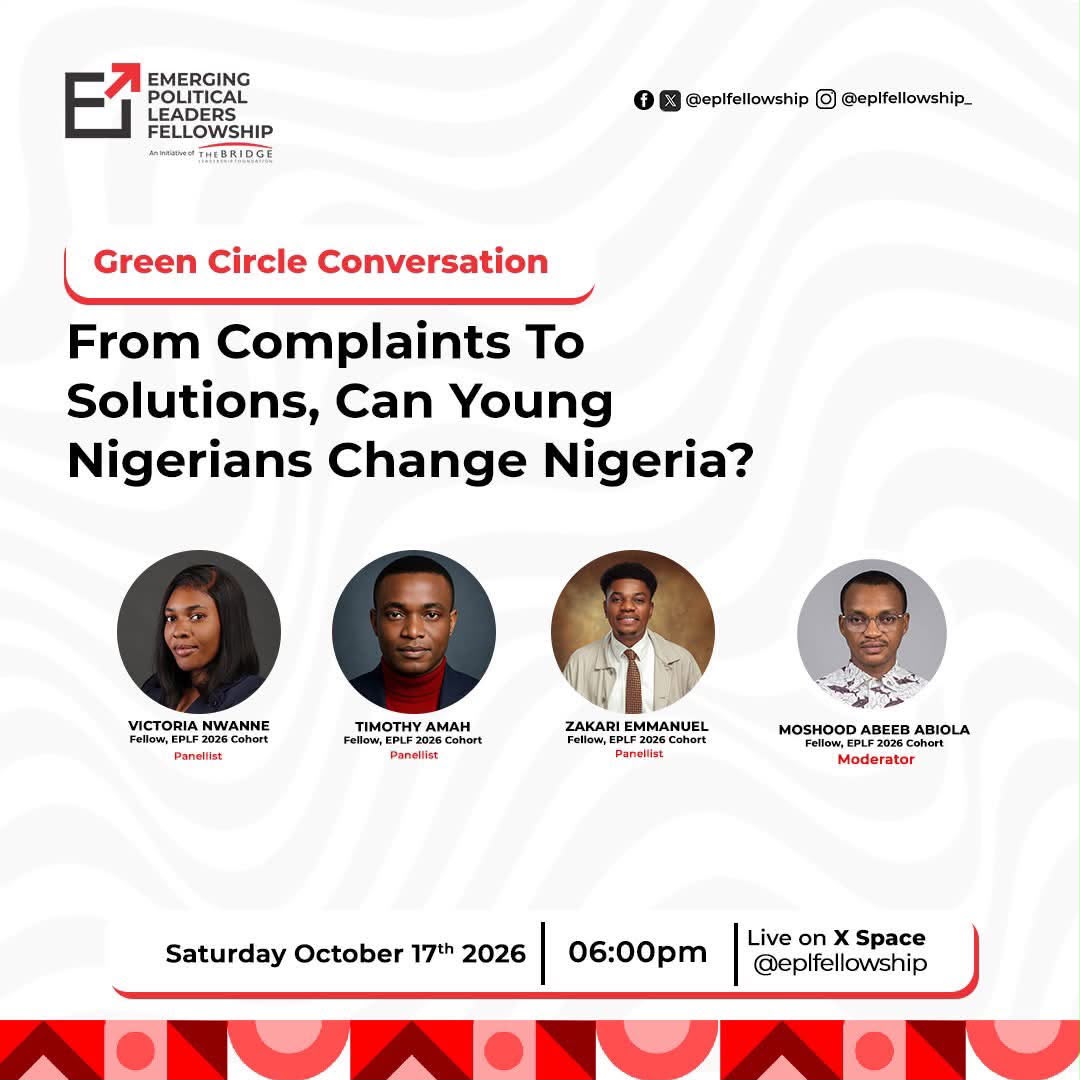
EPLF Fellows Engage in a Green Circle Conversation on Youth Political Participation and the Future of Nigeria
Young Nigerians have consistently demonstrated their passion for a better country, taking to the streets, social media platforms and public spaces to demand accountability, good governance and meaningful change. However, an important question remains: how can this energy and enthusiasm translate into tangible political influence and sustainable national development?
This question formed the centrepiece of a 90-minute Twitter Space organised as part of the Emerging Political Leaders Fellowship (EPLF) Civic Engagement session on 13th October 2026, themed “From Complaints to Solutions: Can Young Nigerians Change Nigeria?”
The conversation brought together three panellists, Victoria, Emmanuel and Timothy, with Moshood Abiola serving as moderator, and 23 active listeners. The session attracted participants who explored the opportunities, challenges and practical steps required to strengthen young people’s participation in Nigeria’s political and governance processes.
Revisiting History and the Place of Young Leaders
The discussion began by examining Nigeria’s political history and the contributions of young people to the country’s democratic journey. The example of Anthony Enahoro, who moved the motion for Nigeria’s self-government in 1953 at approximately 29 years old, highlighted the significant roles young Nigerians have played in shaping the nation’s history.
The panellists reflected on how political leadership gradually became dominated by older generations and questioned what needs to change to create more opportunities for young people to participate meaningfully in governance.
Beyond the Not Too Young To Run Act
A key highlight was an examination of the Not Too Young To Run Act, signed into law in 2018. The legislation reduced the constitutional age requirements for several elective offices, creating greater opportunities for young Nigerians to contest for political positions.
However, the conversation emphasised that reducing age requirements does not automatically guarantee access to political power. Young aspirants continue to encounter challenges such as expensive nomination forms, limited financial resources, godfatherism and entrenched political structures.
The panellists challenged participants to look beyond the existence of the legislation and consider how effectively it has translated into increased youth representation and influence.
From Street Protests to Institutional Change
Reflecting on youth-led movements such as #EndSARS in 2020 and #EndBadGovernance in 2024, the discussion acknowledged the capacity of young Nigerians to mobilise around shared concerns and demand accountability.
However, the panellists highlighted the gap between youth population strength and actual political influence. Although young people constituted a significant proportion of registered voters during the 2023 general elections, voter turnout remained low.
The central message was that protests and online advocacy can raise awareness and demand accountability, but lasting change requires sustained engagement with political parties, electoral institutions and governance structures.
Breaking the Barriers to Youth Political Participation
The conversation identified several obstacles limiting young people’s involvement in Nigeria’s political processes, including:
- High nomination fees: The financial demands of securing party nomination forms discourage many capable young aspirants.
- Godfatherism: Political patronage and established power networks often limit opportunities for emerging leaders.
- Vote buying: Financial inducements undermine electoral credibility and prevent issue-based political participation.
- Voter apathy: Low participation weakens the collective influence of young people in determining electoral outcomes.
The panellists stressed that addressing these challenges requires more than public complaints. It demands deliberate organisation, political education, institutional advocacy and active participation.
The Road to 2027: Turning Conversations into Action
Looking ahead to the 2027 general elections, the session explored practical ways young Nigerians can move from expressing dissatisfaction to actively shaping the country’s political future.
Participants were encouraged to register to vote, obtain their Permanent Voter Cards (PVCs), become members of political parties, participate in ward-level activities and consider contesting for elective positions.
The discussion also emphasised the importance of coalition-building, strategic political alliances and collaboration across generations. Rather than viewing experienced political leaders as competitors, young emerging leaders were encouraged to build meaningful mentorship relationships and leverage the experience of older generations while bringing fresh ideas and perspectives to governance.
Key Lessons from the Conversation
The session reinforced five important lessons:
- Numbers do not automatically translate into power. Young people must complement their demographic strength with organisation, participation and strategic political engagement.
- Legal reforms are necessary but insufficient. While the Not Too Young To Run Act created opportunities, structural and financial barriers must also be addressed.
- Protests create awareness, but organisation drives policy change. Sustainable political influence requires young people to engage continuously with institutions and decision-making processes.
- Online advocacy must translate into offline action. Digital mobilisation should lead to voter registration, community organising, political participation and electoral engagement.
- Intergenerational collaboration strengthens leadership. Combining the energy and innovation of young people with the experience of established leaders can create a more inclusive and effective political environment.
Moving Forward: Building a Generation of Active Citizens
The conversation concluded with an open audience question-and-answer segment, providing participants with an opportunity to engage the panellists further. Each panellist also delivered a one-sentence call to action, reinforcing the need for young Nigerians to take responsibility for shaping the country’s future.
As a follow-up to the session, the EPLF will explore opportunities to develop a youth political participation guide covering voter registration, political party membership and the process of contesting for elective office. Other proposed activities include voter registration and PVC awareness campaigns, mentorship opportunities linking emerging leaders with experienced public servants, and further conversations on critical issues such as the cost of politics ahead of the 2027 elections.
Ultimately, the session challenged young Nigerians to recognise that the responsibility for changing Nigeria cannot rest solely on complaints, hashtags or occasional protests. Meaningful transformation requires informed citizens who are willing to organise, participate, collaborate and hold leadership accountable.
The question is no longer whether young Nigerians can change Nigeria, but whether they are ready to move beyond demanding change and become active participants in creating it.
Through its Emerging Political Leaders Fellowship, The Bridge Leadership Foundation continues to provide a platform for young Nigerians to develop the knowledge, skills and networks required to contribute meaningfully to leadership, governance and national development.
